📰 Recent Articles


The Formula
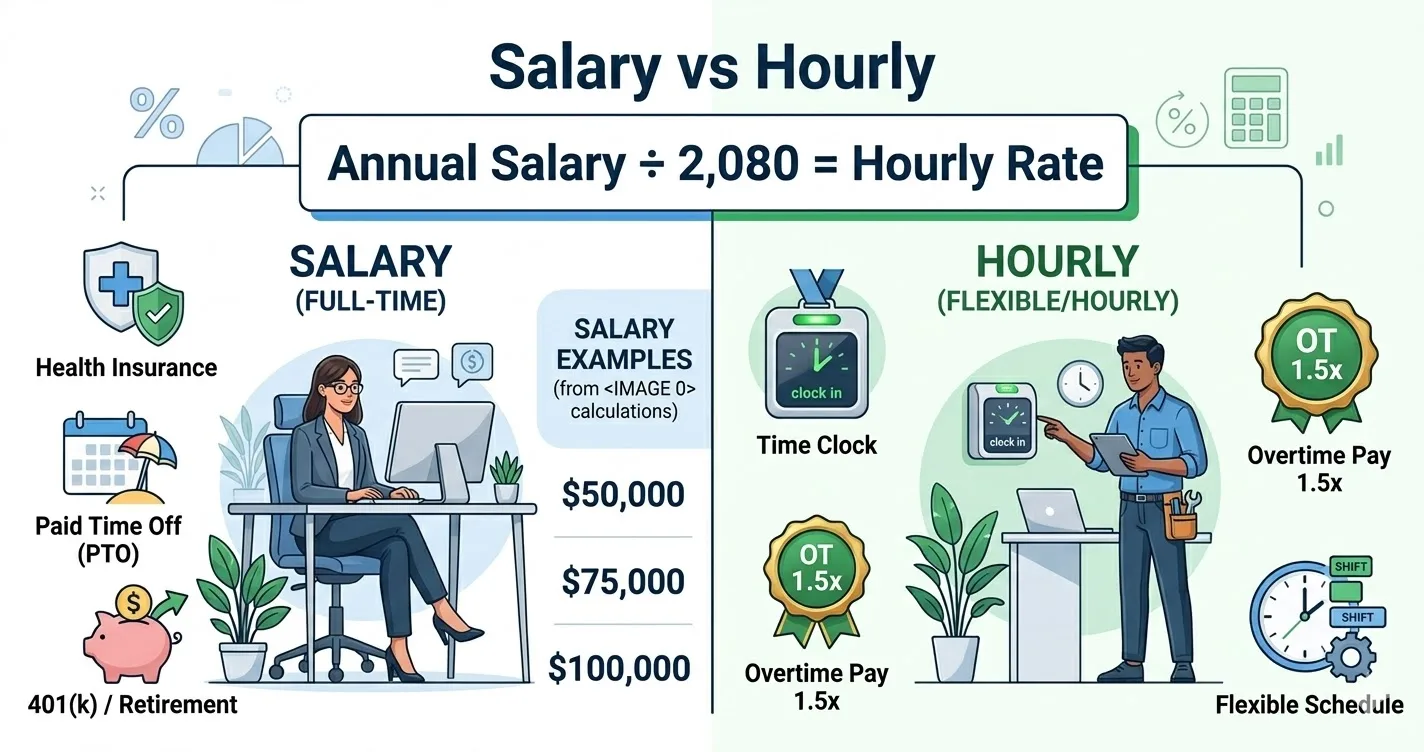
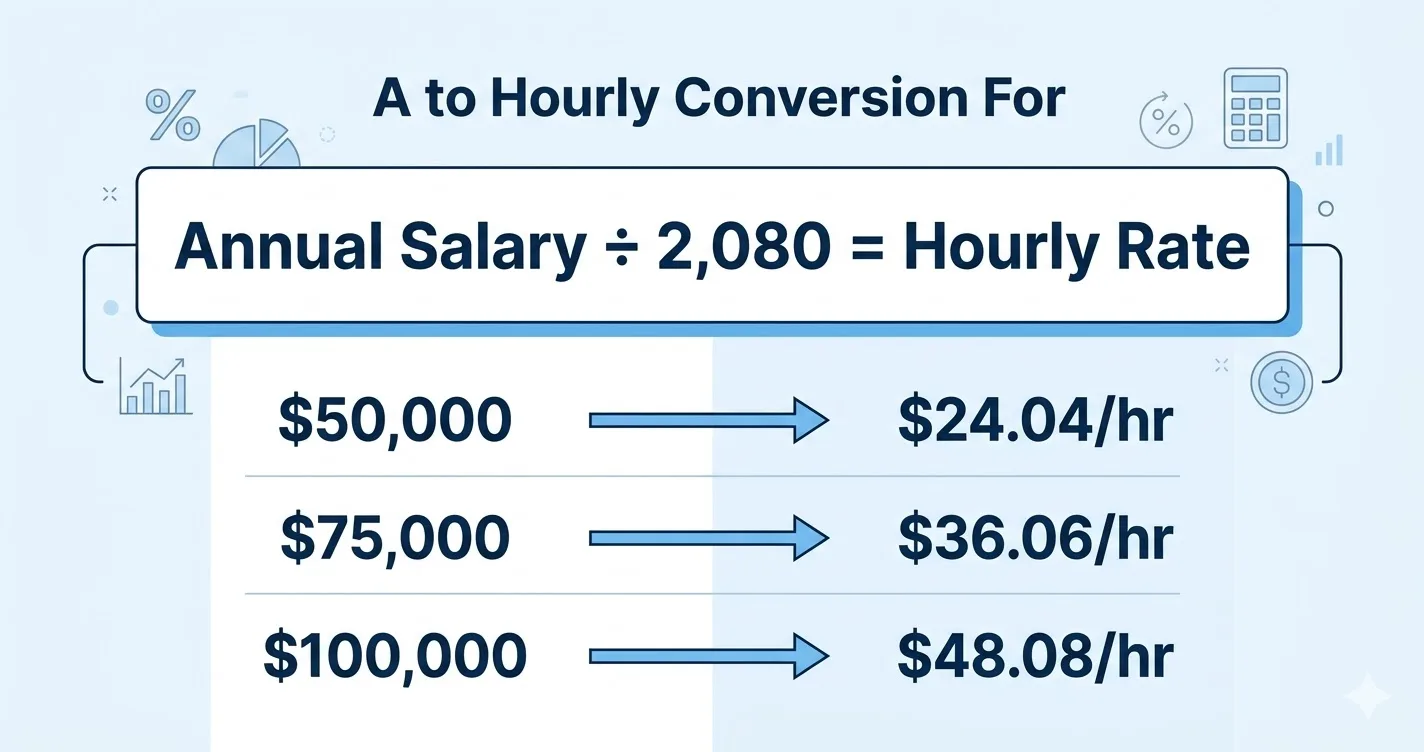
Hourly Rate = Annual Salary ÷ 2,080
2,080 = 40 hours/week × 52 weeks/year
Whether you're comparing a job offer, evaluating a raise, or just curious what your time is worth — this formula is all you need. The number 2,080 is the Bureau of Labor Statistics standard for a full-time work year. Salaried workers still count holidays and PTO as "work hours" since they're paid regardless.
Quick Reference: Salary to Hourly Conversion Table
| Annual Salary | Hourly Rate | Monthly Take-Home* | Full Breakdown |
|---|---|---|---|
| $25,000 | $12.02 | $1,900 | See details → |
| $30,000 | $14.42 | $2,285 | See details → |
| $35,000 | $16.83 | $2,670 | See details → |
| $40,000 | $19.23 | $2,826 | See details → |
| $45,000 | $21.63 | $3,178 | See details → |
| $48,000 | $23.08 | $3,418 | See details → |
| $50,000 | $24.04 | $3,527 | See details → |
| $55,000 | $26.44 | $3,880 | See details → |
| $60,000 | $28.85 | $4,158 | See details → |
| $65,000 | $31.25 | $4,475 | See details → |
| $72,000 | $34.62 | $4,780 | See details → |
| $75,000 | $36.06 | $4,968 | See details → |
| $80,000 | $38.46 | $5,285 | See details → |
| $85,000 | $40.87 | $5,588 | See details → |
| $90,000 | $43.27 | $5,870 | See details → |
| $100,000 | $48.08 | $6,550 | See details → |
| $120,000 | $57.69 | $7,700 | See details → |
| $150,000 | $72.12 | $9,200 | See details → |
*Federal only, single filer, standard deduction. State-specific calculations →
Step-by-Step Examples
Example 1: $52,000 Salary
$52,000 ÷ 2,080 = $25.00/hour
After federal tax (single, standard deduction): ~$20.90/hr effective. Full $52K breakdown →
Example 2: $38,000 Salary
$38,000 ÷ 2,080 = $18.27/hour
This is the equivalent of $18/hr when rounding. At this rate, you're deep in the 12% bracket — see the $30K-$50K guide for tax optimization tips.
Reverse Calculation: Hourly to Salary
Going the other direction? Multiply:
Annual Salary = Hourly Rate × 2,080
For example: $35/hour × 2,080 = $72,800/year. Or $50/hour × 2,080 = $104,000/year.
What About Overtime
Non-exempt workers earn 1.5× their regular rate for hours over 40/week (FLSA). This changes the annual calculation significantly:
| Base Rate | OT Rate (1.5×) | 40 hrs/wk Annual | 50 hrs/wk Annual | OT Bonus |
|---|---|---|---|---|
| $20/hr | $30.00 | $41,600 | $57,200 | +$15,600 |
| $30/hr | $45.00 | $62,400 | $85,800 | +$23,400 |
| $40/hr | $60.00 | $83,200 | $114,400 | +$31,200 |
Variations: Part-Time & Contract Workers
Part-Time (30 hrs/week)
Adjust the formula: Salary ÷ 1,560 (30 hrs × 52 weeks). Example: $30,000 ÷ 1,560 = $19.23/hr.
Contract Work (No PTO)
Contractors typically work ~1,920 billable hours (accounting for unpaid time off). A $100K contract ÷ 1,920 = $52.08/hr — but you also need to cover self-employment tax, insurance, and retirement from that rate.
After-Tax Adjustments
Your "real" hourly rate is after taxes. Quick federal brackets for 2026:
| Taxable Income | Bracket | Salary Range |
|---|---|---|
| $0 – $11,600 | 10% | All salaries |
| $11,601 – $47,150 | 12% | $26K – $62K salary |
| $47,151 – $100,525 | 22% | $62K – $115K salary |
| $100,526 – $191,950 | 24% | $115K – $207K salary |
For precise state-by-state after-tax calculations, use PaycheckWiz →
Skip the Math
Our calculator does this instantly — just enter any salary or hourly rate.
Open Calculator →Sources
Updated March 2026.